You CAN Tier One Your Way Out of an Intervention Problem
You may be familiar with the saying, “You can’t intervene your way out of a tier one problem.” That’s because there’s a general expectation for students in each tier: ~85% of students in Tier 1, ~10% in Tier 2, and ~5% in Tier 3. In a a classroom of 25 students, 21 would be able to receive the daily instruction, 2 or 3 students would need some attention in a small group, and 1 or 2 students would be pulled out to receive separate instruction. The important point is that intervention isn’t designed to replace grade-level instruction—it’s designed to help provide access to grade-level instruction. But if intervention is scheduled at the same time as core instruction, students miss the grade-level instruction they need, which just widens the achievement gap! The good news is that a district I’ve been working with for the past three school years is quickly closing that gap. This is the story of how they found a way to Tier One their way out of an intervention problem.

Let’s go through this case together. in 2024, the state assessment for ELA showed that 33% of fourth graders were in Tier 1 while 33% were n Tier 2, and 33% were in Tier 3. In a class of 25, that means only 8 would be able to access the daily instruction (Tier 1). 17 would need to see an interventionist, either in a small group or in a separate classroom. That’s a problem- an intervention problem.
By 2026, the district had flipped the script. Over the course of 3 school years, student achievement had dramatically increased. 61% of those same students were in Tier 1, 24% were in Tier 2, and about 16% were in Tier 3. That is a major accomplishment: they were able to double the percent of students able to access grade-level reading and writing instruction. They decreased their population of students who needed intervention by half. So how’d they do it? How did this rural district in the plains region tier one their way out of an intervention problem?
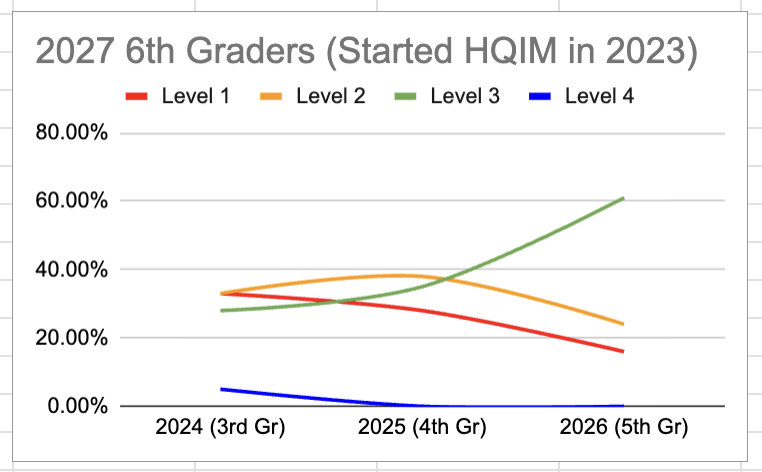
This data shows the achievement over time for the same 45 students. The state assessment ranks students in four levels. For the purpose of this article, Level 1 = Tier 3, Level 2 = Tier 2, and Levels 3 and 4 combine to = Tier 1.
They successfully implemented an HQIM.
They knew they needed a program that would increase the impact of Tier One instruction. After a committee search and pilot, they chose Bookworms K-5 Reading and Writing, authored by Dr. Sharon Walpole. The evidence was clear: when implemented with its enabling conditions, Bookworms increased student achievement. But the work didn’t stop there.
In the first year, the district provided initial curricular onboarding training for all of its teachers, and took advantage of a state initiative that provided additional science of reading training. They invested in on-going coaching (me!) for all teachers and administrators. But the work didn’t stop there.
In the second year, the district provided additional curricular onboarding training for any new teachers, or any teachers who were switching grade levels. They continued to take advantage of state-provided science of reading training. They continued to invest in on-going coaching (me!) for all teachers and administrators. And still, the work didn’t stop there.
From the very beginning, the entire staff poured their professional expertise into implementing Bookworms. They took advantage of coaching opportunities provided by the district and the state, and many sought additional learning opportunities. And the work didn’t stop there.
The district already had a robust after-school tutoring program, and they implemented Bookworms resources there, too. That meant implementation didn’t stop at 3:15. The students in the tutoring program received what we’d call a “double dose” of instruction. But the work didn’t stop there.
Now in their fourth year of implementation, they continue to take advantage of ongoing coaching (me!), provide curricular onboarding training for any new teachers, and invest in additional science-of-reading learning opportunities for their staff.
This case study has two points. One, it proves that successful curricular implementation is not an easy lift- it requires strategic and intentional planning from all stakeholders. But two, it proves that successful implementation of an HQIM for Tier One CAN increase the achievement of all learners.
If you’re on the HQIM-Implementation train, here are some posts you may find helpful:
Questions to Ask Before Choosing an Educational Resource
How the Theory of Change Affects Curriculum Adoption
Intentional Planning for Student Success